


When you press the SOS button on a Garmin inReach in the PNW, this is what happens in the next ten hours. Here is what Steven carries and why every overland rig needs a layered comms stack.
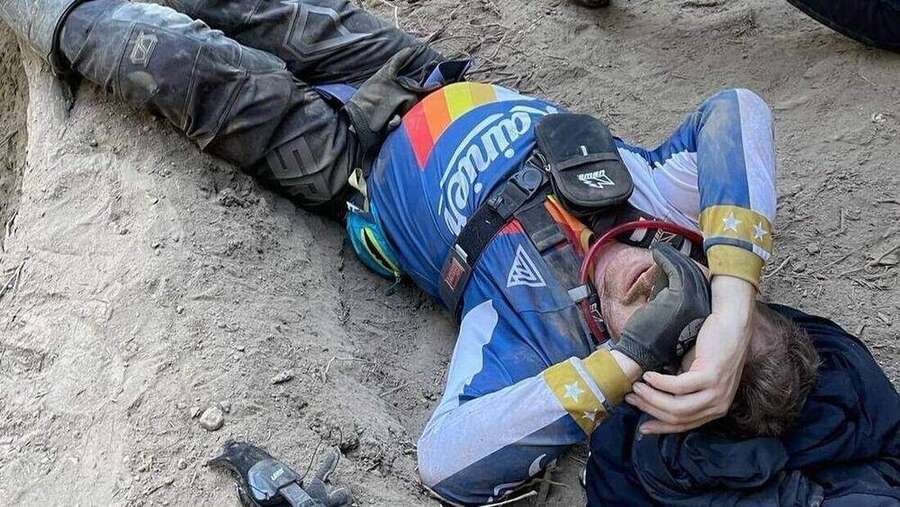
The number is round enough that it sticks in your head. Garmin crossed 10,000 SOS incidents in October 2022, and they have been telling the story of the 10,000th one ever since. It is the story of a 33-year-old Pacific Northwest dirt biker named Kyle McKillop, who rode out for a 60 to 70 mile loop ride he had done many times before, lost his balance on a rooted switchback, and walked out of the hospital ten hours later with a broken tibia, fibula, and dislocated ankle. The reason he walked out, and not got carried out eight hours later by a foot team, is that five other riders in his group all carried Garmin inReach devices, and one of them pressed the SOS button.
What a Garmin inReach SOS Rescue Actually Looks Like
If you have never read the full Kyle McKillop story on Garmin's outdoor blog, it is worth the four minutes. The short version of the timeline reads like a punch list for why two-way satellite messengers have replaced one-way SPOT-style beacons on every serious overland and backcountry rig I run across.
11:30 a.m.: Kyle's foot catches in a root on a switchback he has cleared before. He does not fall off the hill. The bike stays. His foot does not. He hops one-legged to a flat spot on the trail and lies down. He tells his friends to push the SOS button on one of the inReach devices in the group, because he already knows two things about the next ten hours: they are more than 10 miles from the nearest forest road, and the terrain will not let a ground team ride him out. He needs a helicopter.
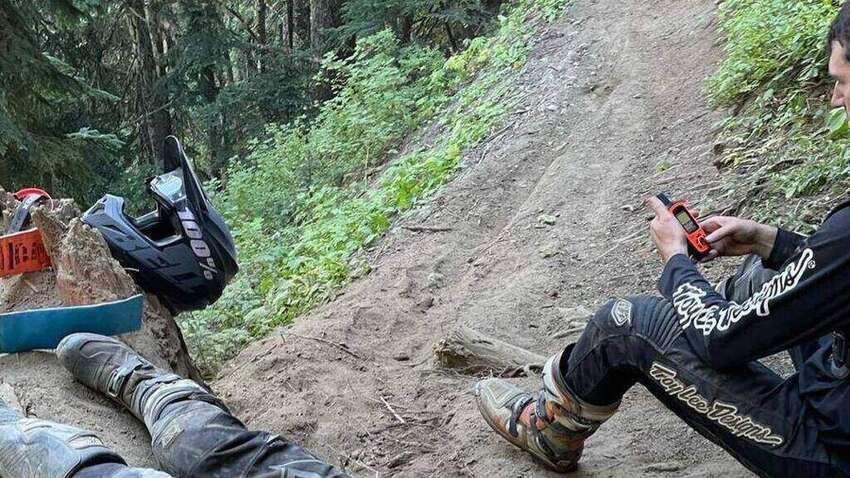
In a matter of minutes, Garmin Response, the 24/7 staffed coordination center that owns the SOS side of every inReach subscription, lets the group know that emergency services have been contacted and dispatched. The coordinator tells them the rescue helicopter does not have a transport basket. Without a basket, a ground extraction would have taken eight hours by foot. So the group has to do three things while the helicopter flies in.
- Build a stretcher from paracord and branches. They get Kyle loaded onto it.
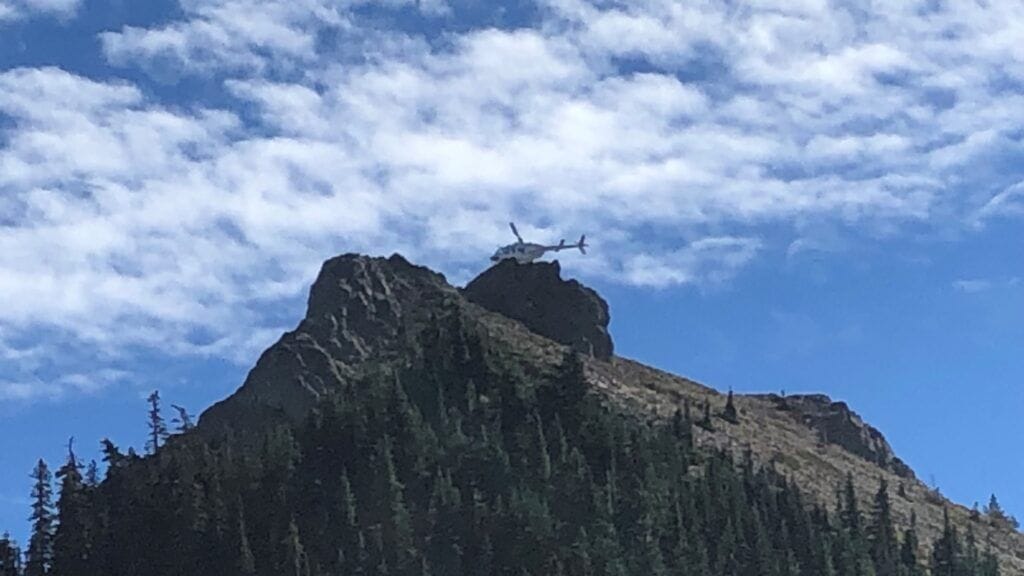
- Carry him to a ridgeline where the helicopter has a chance of landing.
- Stack rocks on the ridgeline to flatten a landing zone. The pilot calls it "one of the sketchier rescues" he has ever done.
9:30 p.m.: Kyle is home. Ten hours. Forty-five-minute helicopter flight, then forty-five more in the ambulance, then the rest at the hospital with the broken leg and the dislocated ankle. He says it in the Garmin interview exactly the way I would say it, and exactly the way anyone who has actually used an inReach in anger would say it: knowing the rescue team was responding with his exact GPS location helped him stay calm through the worst ten hours of his life.

That is the chain. That is what an inReach SOS rescue actually looks like when it works. It is not a phone call. It is a button press on a small orange device, a coordination conversation with a human at Garmin Response, and a helicopter that knows exactly where you are because the Iridium satellite network behind the device has been pinging your GPS position every few minutes for the last ten miles of trail.
Why the Layered Comms Stack Matters
If you have read any of the Whiskey7backroads comms pieces, including the onX SOS review, the Starlink Mini era post, and the adventure mobile HF ham radio guide, you know I think of off-grid communications as a layered stack, not a single device. The McKillop story is the clearest reason why.

On a typical PNW weekend trip, I run four communication layers, in order of how often they matter.
- Cell phone with onX and Gaia for navigation. Works at the trailhead, works at most established Forest Service campgrounds, dies the second the road dips into a canyon or the trees close in. Useful for 80% of trip communication and useless for the 20% that gets you hurt.
- GMRS radio for vehicle-to-vehicle in a convoy. Per the FCC's GMRS definition, GMRS handhelds push 5 watts and mobile units up to 50 watts, and you need a license to transmit. Range is one to five miles in real PNW terrain, sometimes fifteen on a clear ridge. Great for keeping two trucks together on a tight forest road. Useless the moment the trail forks or someone gets hurt out of earshot.
- Amateur (ham) radio for repeater-linked regional comms. Per the Ham Radio Prep range comparison, CB tops out at three to five miles, GMRS at five to twenty-five in good conditions, and ham on VHF/UHF through a repeater can be hundreds of miles. With HF and good propagation, it is thousands. The license is $35 to take the Technician exam, the gear starts at $35 for a Baofeng handheld, and you can run APRS to broadcast your GPS position over ham without paying Garmin a subscription.
- Garmin inReach (or equivalent two-way satellite messenger) for the SOS chain, check-ins, and short text where nothing else works. This is the layer McKillop needed and the layer most overlanders skip.
If you want a deeper dive on the radio side, the XOverland layered comms guide is the cleanest public articulation of the multi-device philosophy I have read, and Brent's W7BR ham radio page is where I keep my own setup notes including APRS digipeater coverage in the Cascades.
What's Actually in My Pack: The Comms Stack I Run

I am not going to bury the lede: every PNW trip I run, no matter how short, has a Garmin inReach in it. That is not an aspirational gear list. That is what is in the pack right now. Here is what is in it and why.
- Garmin inReach Mini 2 (or Mini 3 Plus if I am carrying a heavier kit). The Mini 2 weighs 3.5 oz and lives on my pack strap. The Mini 3 Plus is the new top pick per GearJunkie's 2026 satellite messenger roundup, with multi-band GNSS, a 1,600-character message limit, and the ability to send a 30-second voice memo or photo via satellite for $500. For most of my trips the Mini 2 with the late-2024 Consumer: Essential plan ($14.99 a month, 50 messages) is the right balance of weight, cost, and capability.
- The Iridium constellation behind every inReach. This matters more than people realize. Iridium is a 66-satellite low-Earth-orbit constellation that gives true global coverage including the poles, and the inReach is one of a handful of consumer devices that uses it. The Garmin inReach Mini 2 product page walks through the hardware.
- GMRS mobile (Midland MXT275 or equivalent) in the truck for convoy comms. License cost is $35 for ten years, and I keep the FCC paperwork in the glove box.
- Yaesu FTM-400XDR ham mobile for VHF/UHF, plus a 50-watt amp for repeater work. I run APRS in the truck so my wife can see my dot moving up the highway on aprs.fi. Per Ham Radio Prep's mobile radio list, the FTM-400XDR is one of the better touchscreen dual-band APRS rigs in the under-$500 bracket.
- Starlink Mini for connected remote work weeks, not for safety. Per the W7BR Starlink Mini era post, the Mini is the missing internet layer, not the missing SOS layer. If you press the SOS button on a Starlink Mini you get nothing. If you press it on an inReach, you get a helicopter.
Where a Two-Way Messenger Sits vs. GMRS vs. Ham vs. Starlink

People argue about which of these four is enough. The honest answer is that they cover four different failure modes, and any one of them can be the layer that fails on the day you need it. Here is how I think about each layer, and where each one breaks first.
Cell and onX SOS
The newest layer is the onX SOS button, which I covered in detail in the W7BR onX SOS review. It is $49.99 a year, powered by Overwatch x Rescue, no new device to charge, and it shows up in the same app you already use to plan routes. The catch is that onX SOS still depends on your phone being functional and charged, and the only satellite fallback is one of three pre-registered hardware messengers (inReach, SPOT X, or ZOLEO). I run both layers: onX SOS as the primary if my phone is alive, inReach as the always-on hardware backup.
GMRS radio
GMRS is the right answer for talking to the truck behind you. It is the wrong answer for talking to a helicopter. Range tops out in the five to twenty-five mile band in real terrain, and that is generous. If you fall off the trail and your buddy is in the truck half a mile below you on the same road, GMRS works. If you fall off the trail and the truck is twelve miles of forest away, GMRS is silent.
Ham radio (VHF/UHF and HF)
Ham is the answer for the middle distance: talking to other hams across a region through a repeater, or across a continent on HF when the bands cooperate. The W7BR POTA activation piece I wrote is the practical version of how this works on a real trip. Ham is also the only layer where you do not pay a subscription to anyone for the privilege of using the network. The trade-off is the license, the antenna install, and the fact that ham repeaters are owned and maintained by other volunteers. In a real emergency on a backcountry trail, your ham signal is not what brings the helicopter. It might bring another ham who can relay to a sheriff's frequency, but that is two hops and three things that have to go right.
Starlink Mini
Starlink Mini is the answer for a remote work week or a family movie night at camp. Per the W7BR Starlink Mini era post, the 1.10 kg USB-C PD-powered dish is the moment off-grid internet became useful, not a novelty. What Starlink Mini is not, is a safety layer. There is no SOS button. There is no two-way text to a coordinator. If you mash the Starlink Mini and ask for help you get the open internet, which is wonderful and also exactly the wrong thing when you are bleeding on a mountainside. The Starlink Mini is layer three or four. It is not layer one.

What 10,000 SOS Incidents Taught Garmin (and What I Took From It)
The McKillop story is one of ten thousand. Garmin has been quietly publishing the post-incident interviews and the field data since they crossed the milestone, and the pattern that emerges from reading a dozen of them is the same every time. The device works. The human coordination works. The thing that varies is the terrain and the time between SOS press and rescue arrival.

Three things I took from reading the McKillop post and the rest of Garmin's SOS writeups, applied to my own pack:
- Two-way is non-negotiable. SPOT-style one-way beacons tell someone you need help, but they cannot tell you the helicopter ETA, cannot tell you the LZ is too rough, cannot let you text back that the patient has deteriorated. Every credible review of the segment now says the same thing, including GearJunkie's 2026 satellite messenger roundup. Two-way wins.
- Subscription tier matters less than you think. The cheapest Iridium plan still gives you unlimited SOS and 10 free messages. You can pay $14.99 a month for the late-2024 Consumer: Essential plan and get 50 messages, or step up to inReach Plus for voice memos and photos. For most weekend trips, the basic plan is enough. What is not enough is no subscription at all.
- The button is not the hard part. The hard part is having charged batteries, knowing the device is on, and having practiced the message you would send. Most people buy an inReach, leave it off for six months, and discover it is dead when they need it. The fix is boring: charge it the day before, leave it on, and send a check-in message on every trip even when nothing is wrong. Treat it like the fire extinguisher in the truck.
A Practical Comms Checklist Before the Next Trip
This is the actual checklist I run through the morning of every overland trip, copied from the laminated card in my truck. Print it. Tape it to the dash. Edit it for your own rig.
- inReach charged to 100% the night before. Subscription active. Preset messages set (one for "checking in, all good," one for "running late but fine," one for "turning around"). Two contacts set as emergency with their phone numbers, not just email.
- Phone at 100%. onX downloaded the region. Gaia downloaded the region as backup. Battery case charged. Car charger in the truck.
- GMRS radio on, channel set, volume audible from the driver's seat. Repeater channel programmed if the area has one. License in the glove box.
- Ham radio on, simplex calling frequency set, repeater frequency set if there is one in range. APRS beacon running so my position is broadcasting. If the trip is HF, antenna tuned and band conditions checked.
- Starlink Mini stowed, cable checked, router charged. The Mini is layer three, not layer one, so it does not need to be live before departure, but it needs to be ready if I plan to stop for a remote work block.
- Trip plan filed. Not on a phone app that might be dead. On paper, in the truck, with the route, the expected return time, and the bail-out plan written down. The person who is not on the trip gets a copy. Per the W7BR onX SOS review, this is the single most useful thing you can do, and most overlanders skip it.

FAQ: Off-Grid Comms for Overlanders
Do I really need an inReach if I have a cell phone and onX SOS?
Yes. Cell phones die, get wet, fall off the truck, run out of battery, and lose signal in canyons. onX SOS depends on the phone being alive. The inReach is a separate piece of hardware with its own battery and its own Iridium satellite link. The two layers are not redundant. They are backups of each other, and you want both in the truck on every trip.
Is a $150 SPOT Gen4 enough?
If all you want is the big red SOS button and an occasional "I am OK" ping, yes. SPOT Gen4 is a one-way device, which means the SOS goes out but no two-way text comes back. Per GearJunkie's 2026 roundup, that is the budget answer. If you want to negotiate an LZ, ask about patient condition, or coordinate with a friend on a different route, you need two-way. That is inReach, ZOLEO, or SPOT X.
How much does Garmin inReach cost per month?
The current Consumer: Essential plan is $14.99 a month with 50 messages and unlimited SOS. The step-up Consumer: Standard plan is higher with more messages and the inReach Plus features. Annual commitments are cheaper than month-to-month, but the late-2024 update made month-to-month viable. See the current Garmin inReach subscription page for the live numbers.
Is Starlink Mini a substitute for inReach?
No. Starlink Mini has no SOS button, no two-way text to a human coordinator, and no equivalent of Garmin Response. It is a brilliant connected-camp device and a useless safety device. Carry both, or carry inReach and skip the Starlink until you have a real comms stack in place.
Can I use ham radio instead of inReach?
Technically, no. Ham radio cannot page a professional emergency coordination center the way an inReach can. Practically, sometimes. A ham operator on a repeater can relay to a 911 center, and ARES (Amateur Radio Emergency Service) groups do real search-and-rescue liaison work. But that is two hops through volunteers and depends on someone being at the other end of the repeater. The inReach is one hop to a paid coordinator. They are different tools. The W7BR ham radio page has my notes on the actual setup.
What about Apple iPhone satellite SOS or T-Mobile Starlink?
Both are real and both work. Both also depend on your phone being alive. Apple iPhone satellite SOS is free for the next two years with every new iPhone, and T-Mobile Starlink text is rolling out across the US. Both are excellent secondary layers. Neither replaces a hardware satellite messenger with its own battery. Carry one of the hardware devices regardless.

About the Author
Steven Marty
My name is Steven Marty, I am a guest contributor to the Whiskey 7 Backroads blog.
View all posts by Steven →